
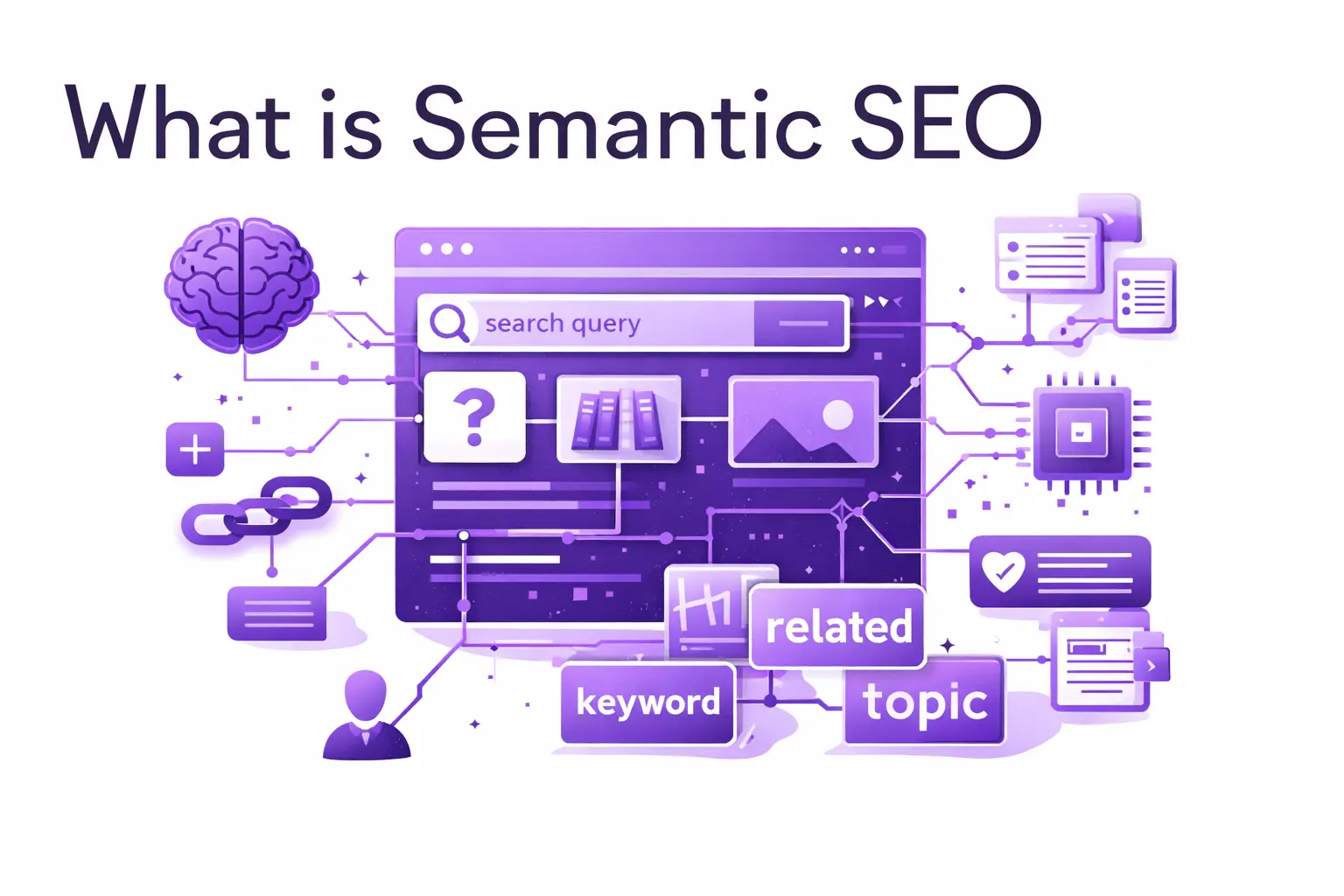
Semantic SEO is the practice of optimizing content based on meaning, context, and relationships between topics rather than focusing solely on individual keywords. This approach aligns with how modern search engines like Google understand language, using natural language processing (NLP), machine learning, and entity recognition to decode not just what words appear on a page, but what those words actually mean in relation to user intent. Unlike traditional keyword-focused SEO that prioritized exact-match phrases and keyword density, semantic SEO creates content around comprehensive topics that thoroughly address user needs.
The significance of semantic SEO in 2026 cannot be overstated as search technology continues evolving toward AI-powered understanding. Research demonstrates that websites using semantic optimization strategies achieve 2x more featured snippet placements and significantly better visibility in AI-generated search results. With over 90% of content receiving zero organic traffic from Google, simply using “right keywords” no longer suffices you must create content that search engines understand contextually and that genuinely satisfies user intent. As Google’s algorithms become increasingly sophisticated at understanding meaning rather than just matching keywords, semantic SEO has transformed from an advanced tactic to an essential foundation of effective search optimization.
Understanding the evolution of semantic search helps clarify why this approach dominates modern SEO strategy and what changes shaped today’s search landscape.
Google’s journey toward semantic understanding began with several landmark algorithm updates that fundamentally changed search technology. The Knowledge Graph launched in 2012 introduced entity-based understanding, allowing Google to recognize relationships between people, places, things, and concepts rather than treating everything as isolated keywords. This massive database now contains over 800 billion facts about 8 billion entities, forming the foundation of semantic search.
The Hummingbird update in 2013 marked Google’s movement toward conversational search understanding. Rather than analyzing keywords individually, Hummingbird enabled Google to comprehend entire query meanings, particularly benefiting voice search and natural language queries. This update represented a fundamental shift from keyword matching to intent interpretation.
RankBrain arrived in 2015 as Google’s first major machine learning integration, using artificial intelligence to better understand ambiguous queries and match them with relevant content even when exact keyword matches don’t exist. RankBrain learns from user behavior patterns to improve result relevance continuously.
BERT launched in 2019 to enhance contextual understanding through bidirectional analysis reading words in relation to all other words in a sentence rather than sequentially. BERT dramatically improved Google’s ability to understand nuanced language, prepositions, and context-dependent meanings.
Traditional keyword-focused search faced fundamental limitations that semantic understanding solves. Keywords alone cannot capture meaning the query “apple” might refer to fruit, the technology company, a record label, or New York City depending on context. Keyword matching struggles with synonyms, related concepts, and different ways of expressing the same idea. Users increasingly search using natural language and complete questions rather than keyword strings, particularly with voice search adoption.
The semantic approach recognizes that someone searching “best beginner running shoes,” “top shoes for new runners,” and “what shoes should I buy to start running” all seek the same information despite using different words. Modern algorithms understand these queries represent identical intent, returning similar results optimized for meaning rather than specific phrasing.
Several foundational concepts underpin effective semantic SEO strategy and distinguish it from traditional optimization approaches.
Entities represent distinct concepts, people, places, brands, or things that Google recognizes as connected topics with defined relationships. Unlike keywords which are simply text strings entities carry meaning, context, and associations that help search engines understand content comprehensively.
For example, “Chicago” exists as an entity with attributes including being a city in Illinois, the third-largest U.S. city, home to specific landmarks, associated with particular cuisine styles, and connected to various cultural and historical elements. When content mentions Chicago, Google doesn’t just see a keyword; it understands the entity and how it relates to other entities mentioned on the page.
Entity-based optimization means creating content that clearly establishes relevant entities and their relationships. A restaurant website in Chicago should connect the business entity to the location entity, cuisine type entities, and potentially chef or signature dish entities. This semantic richness helps search engines understand exactly what the content offers and when to surface it.
Natural Language Processing (NLP) enables computers to understand, interpret, and generate human language in valuable ways. Google’s NLP capabilities allow it to analyze content like humans would understanding context, sentiment, relationships between concepts, and subtle meaning variations based on word choice and sentence structure.
NLP processes content to identify main topics, supporting concepts, entity relationships, sentiment and tone, question-answer relationships, and content quality signals. This technology powers Google’s ability to match content with search intent even when exact keyword matches don’t exist.
For content creators, NLP’s dominance means writing naturally for human readers serves SEO better than awkwardly forcing keywords into text. Conversational, clear writing that thoroughly addresses topics aligns with how NLP systems process and evaluate content quality.
Search intent represents what users actually want when they search specific queries and falls into four primary categories. Informational intent indicates users seeking knowledge or answers to questions. Navigational intent shows users looking for specific websites or pages. Commercial intent reveals users researching products or services before purchasing decisions. Transactional intent demonstrates users ready to complete actions or purchases.
Semantic SEO requires matching content types and formats to search intent. Even with strong keyword optimization, if your content format doesn’t align with intent, it won’t rank or convert effectively. Someone searching “what is semantic SEO” has informational intent requiring comprehensive explanations. Someone searching “semantic SEO consultant near me” has transactional intent needing service pages with clear contact options.
Analyze top-ranking results for target keywords to understand Google’s intent interpretation. If results predominantly show detailed guides, create comprehensive informational content. If results display product pages and reviews, optimize for commercial or transactional intent. Never fight against established intent patterns align your content format with what successfully serves specific queries.
Topic clusters represent one of the most effective semantic SEO strategies, organizing content around comprehensive topical coverage rather than isolated keyword targeting.
Topic clusters organize website content into interconnected networks centered on broad pillar pages with related cluster content providing detailed subtopic coverage. This hub-and-spoke model signals topical authority to search engines while creating intuitive user navigation.
A pillar page provides a comprehensive overview of a broad topic without excessive detail on every aspect that’s what cluster content addresses. For example, a “Digital Marketing” pillar page might cover email marketing, SEO, content marketing, social media, and paid advertising at high levels, with each linking to dedicated cluster pages diving deep into specific subtopics.
Cluster pages explore specific angles, questions, or elements of the broader pillar topic. These pages target more specific long-tail keywords while linking back to the central pillar page. This bidirectional linking creates clear semantic relationships that help search engines understand your content organization and topical expertise depth.
Research consistently demonstrates topic clusters’ performance advantages over traditional scattered content approaches. Content organized into clusters drives approximately 30% more organic traffic and maintains rankings 2.5 times longer than standalone posts according to 2025 industry analysis.
Topic clusters establish topical authority by demonstrating comprehensive subject coverage. Google’s algorithms increasingly reward sites that thoroughly address topics from multiple angles rather than creating isolated keyword-targeted posts. A professional seo company los angeles implementing topic clusters for clients consistently sees better results than those pursuing traditional one-post-per-keyword strategies.
Clusters improve internal linking structure naturally, distributing link equity effectively throughout related content. This interconnected architecture helps search engines discover and understand content relationships while keeping users engaged longer as they explore related information. Sites with well-structured clusters typically see lower bounce rates and higher pages-per-session metrics both positive ranking signals.
Building successful topic clusters requires strategic planning and systematic execution rather than ad-hoc content creation.
Start by identifying core pillar topics central to your business and audience needs. Pillar topics should be broad enough to support 8-15 cluster articles while remaining focused enough to demonstrate clear expertise. Ask yourself what topics your customers care about throughout their buying journey, then validate choices through keyword research and competitor analysis.
Conduct comprehensive keyword research for each pillar, identifying the main broad keyword for the pillar page plus related long-tail keywords for cluster content. Analyze top-ranking content to identify coverage gaps and opportunities for differentiation. The goal isn’t simply matching existing content but providing superior value through depth, clarity, and comprehensiveness.
Create your pillar page as authoritative, long-form content (typically 2,000-5,000+ words) providing complete topic overview with clear organization and navigation. Include a table of contents enabling quick navigation to relevant sections. Structure with proper heading hierarchy (H1 for title, H2 for main sections, H3 for subsections) and incorporate relevant visuals, examples, and actionable advice.
Develop 8-15 cluster pages exploring specific subtopics in depth. Each cluster page should target specific long-tail keywords while providing genuine value beyond the pillar page’s overview. Maintain consistent quality across cluster content don’t rush inferior posts just to complete the cluster.
Implement strategic internal linking connecting pillar and cluster pages bidirectionally. The pillar should link to each cluster page when introducing related subtopics. Every cluster page should link back to the pillar using relevant anchor text that reinforces main keywords. This creates clear semantic pathways for both users and search engines.
Schema markup provides explicit semantic signals helping search engines understand content context and relationships with precision that content alone cannot achieve.
Schema markup uses standardized vocabulary from Schema.org to tag content elements, explicitly telling search engines what specific content represents. Rather than forcing algorithms to infer meaning from text alone, schema provides machine-readable context that eliminates ambiguity.
Different schema types suit different content including Article schema for blog posts marking publish dates, authors, and article specifics; Product schema for ecommerce items showing prices, ratings, availability, and specifications; LocalBusiness schema for companies with physical locations including addresses, hours, and service areas; FAQ schema for question-answer content enabling rich result displays; HowTo schema for step-by-step instructions showing duration and required materials; and Review schema for ratings and testimonials with structured rating information.
Implementing a schema doesn’t directly improve rankings but enhances search visibility through rich results that occupy more visual space, provide immediate value to searchers, and typically achieve higher click-through rates than standard listings. For businesses targeting geographic markets, a local seo houston company might implement LocalBusiness schema combined with location-specific content to dominate local search results.
JSON-LD represents the recommended schema markup format because it clearly separates structured data from visible page content, simplifies implementation and maintenance without touching HTML extensively, and provides flexibility to modify schema independently from content changes.
Implement JSON-LD by adding JavaScript code within your page’s <head> or <body> tags containing structured data describing your content. Validate implementation using Google’s Rich Results Test to ensure proper formatting and identify errors preventing rich result eligibility. Monitor performance through Google Search Console’s Rich Results report tracking impressions, clicks, and issues requiring attention.
Comprehensive content covering topics thoroughly rather than superficially directly supports semantic SEO principles and algorithmic preferences.
Top-ranking pages consistently demonstrate substantial content depth, averaging 1,890 words according to industry studies, though optimal length varies by topic complexity and user needs. Long-form content performs better not because algorithms reward word counts but because thorough topic coverage requires substantial content to address comprehensively.
Comprehensive content naturally incorporates semantic variations, related concepts, and multiple angles addressing diverse user needs within single resources. This completeness signals topical authority while satisfying various user intents that might drive traffic to your page. Someone searching “semantic SEO” might want definitions, implementation strategies, tool recommendations, or case studies comprehensive content addresses all these angles.
However, length alone doesn’t guarantee success. Content must deliver genuine value throughout without padding or repetition simply to reach arbitrary word counts. A focused 1,000-word article thoroughly answering specific questions outperforms a 3,000-word article filled with fluff and redundancy. Let topic complexity and comprehensiveness requirements dictate length rather than targeting specific word counts.
Semantically rich content comprehensively covers topics using varied vocabulary, addresses related concepts and questions, naturally incorporates synonyms and semantic variations, includes relevant examples and applications, and connects to broader contexts and relationships.
Rather than repeating exact keywords, semantically rich content explores topics from multiple perspectives using natural language variations. A piece about “email marketing” might discuss newsletter strategies, email automation, subscriber engagement, deliverability optimization, and email campaign analytics without forcing “email marketing” into every paragraph.
Answer related questions users might have about your topic. Use tools like AnswerThePublic or analyze “People Also Ask” boxes to identify common questions surrounding your subject. Including FAQ sections addresses these queries while enriching semantic relevance.
Even experienced marketers make errors that undermine semantic SEO effectiveness and limit content performance.
Some content creators mistakenly believe semantic SEO means adding more keywords, leading to awkward, over-optimized content that damages user experience and triggers algorithmic penalties. Modern NLP algorithms easily detect unnatural keyword density and over-optimization patterns.
Write naturally for human readers first, allowing keywords and semantic variations to appear organically through comprehensive topic coverage. If content reads awkwardly or feels repetitive, you’re likely over-optimizing. Read content aloud if it sounds unnatural, revise for clarity and flow rather than keyword inclusion.
Creating excellent content that doesn’t match search intent guarantees poor performance regardless of optimization quality. If users searching your target keywords want quick answers but your content provides lengthy background context before addressing their question, they’ll bounce seeking faster solutions elsewhere.
Analyze top-ranking content to understand intent Google has identified for specific queries. Match your content format, depth, and structure to successfully serve that intent. When formats don’t align with your strengths or goals, target different keywords with intent matching your content capabilities.
Failing to implement strategic internal linking wastes topic cluster benefits and leaves search engines unable to fully understand your content relationships. Disconnected cluster pages confuse both algorithms and users about how content pieces relate.
Every cluster page should link back to its pillar page using relevant anchor text. Pillar pages should link to each cluster when introducing related subtopics. Additionally, link between related cluster pages when naturally referencing related concepts. This comprehensive internal linking creates clear semantic pathways reinforcing topical relationships.
Outdated content undermines semantic SEO by reducing relevance and authority signals. Content accuracy and freshness increasingly influence rankings, particularly for topics subject to change or development.
Implement regular content audits identifying pages requiring updates. Refresh statistics, add new sections addressing recent developments, remove outdated information, and improve clarity based on user feedback and performance data. Updated content often outperforms new content on the same topic because it maintains accumulated authority while demonstrating currency.
Semantic SEO represents the present and future of effective search optimization as algorithms grow increasingly sophisticated at understanding meaning, context, and user intent. The shift from keyword-focused tactics to meaning-driven strategies aligns with how users naturally search and how search engines interpret queries.
Success in semantic SEO requires fundamental mindset changes from targeting keywords to covering topics comprehensively, from isolated posts to interconnected content clusters, from keyword density to semantic richness and natural language, and from technical manipulation to genuine value and expertise demonstration.
Begin implementing semantic SEO by auditing existing content to identify opportunities for consolidation into topic clusters. Identify your most important topics, then map existing content that relates to each. Create pillar pages for topics lacking them, develop cluster content filling gaps in topical coverage, and implement strategic internal linking connecting related content clearly.
Research keywords not just for volume and difficulty but for understanding search intent and semantic relationships. Use tools analyzing entity recognition, semantic proximity, and topical authority to optimize beyond basic keyword metrics. Implement appropriate schema markup providing explicit context search engines can interpret definitively.
Write naturally for human readers using conversational language addressing topics comprehensively. Include semantic variations, answer related questions, provide practical examples, and connect concepts to broader contexts. Let thoroughness and clarity drive content length rather than arbitrary word count targets.
Monitor performance measuring not just rankings but also featured snippet captures, rich result appearances, and AI-generated summary inclusions. As search continues evolving toward answer engines and AI-powered results, semantic optimization positions your content for visibility across these emerging formats.
The businesses and websites dominating search results in 2026 and beyond will be those treating semantic SEO not as an advanced tactic but as the foundation of their entire content strategy. By focusing on meaning, context, and comprehensive topical coverage, you create content that serves both sophisticated algorithms and the human users they aim to satisfy.